1. Home
  2. The ten levels
  3. Level Pre-A

Calibrated Practice

CAT4Level Pre-A

Ages 7–8Year 3 in UK schools

492 questions, and every one of them explains all five options. All four tests taught before they are tested, then five complete mock tests. Written to be read aloud with the child.

Paperback, 8.5 × 11 in, 215 pages. Revised edition, November 2026. ISBN 979-8-16-215645-1.

Front cover of CAT4 Level Pre-A Practice Book: Year 3, Ages 7-8
  • 4tests, each one taught
  • 64practice questions, easiest first
  • 5full mock tests, 84 questions each
  • 492questions in all, with 8 worked examples

Is this the right book?

Level Pre-A is the version a school normally uses in Year 3, with children aged 7–8. The school chooses the level from the year group, not the parent. Level Pre-A is the other Year 3 level, used mainly by international schools in place of Level Y.

If your child is in a different year, find the right level. If in doubt, ask the school which level it uses.

What is in it

  • Four taught chapters, one per test: the method, the traps that catch children out, two worked examples, then 16 practice questions from easy to hard.
  • Five complete mock tests of 84 questions, in the real two-part order and to the published time limits, with an error grid to mark against.
  • 492 worked answers, not 492 answer letters. Every question explains the option that is right and the four that are not.
  • A chapter for the adult: reading the school’s report, pacing, English as an additional language, access arrangements, and when to stop.

The Level Pre-A paper

Timings as published by GL Assessment. GL does not publish question counts at this level; the mock tests in the book use the widely reported 24, 24, 18 and 18.

From the book

One question from each test, answered the way the book answers it.

These are worked examples printed in the Level Pre-A book. Try each one, then open the answer: all five options are explained, and each wrong one has its trap named.

Non-Verbal Reasoning · Part 1 · 10 minutes

Figure Classification

Three pictures sit together on the left. They are alike in some way. On the right are five more pictures, labelled A to E. Exactly one of them is alike in the same way, and that is the answer. Nobody says what the rule is: finding it is the question.

Traps the chapter names: shape-match · near-miss · half-rule · salient · none

Figure Classification · worked example

ABCDE
Show the answer, and why each of the other four is wrongHide the answer
Answer B
The rule: every picture has stripes that go across. The shape varies, so it cannot be the rule.
B (leaf with stripes that go across) is the only option that fits it.A is plain grey, with no stripes that go across.C has stripes that go up and down, not stripes that go across.D has diagonal stripes, not stripes that go across.E has stripes that go up and down, not stripes that go across.Traps: A shape-match · C shape-match · D none · E near-miss

Verbal Reasoning · Part 1 · 10 minutes

Verbal Classification

Three words are given. They belong together in some way. Five more words are printed underneath, labelled A to E. One of them belongs with the three and four do not. Choose the one that belongs.

Traps the chapter names: near-category · associated · opposite

Verbal Classification · worked example

chimney, floor, stairs
AsofaBkeyCaddressDwallEcaravan
Show the answer, and why each of the other four is wrongHide the answer
Answer D
The group: parts of a house.
D (wall) belongs. A wall is part of a house.A (sofa) is kept inside a house, but it is not built into it.B (key) is what you lock the front door with, not part of the house.C (address) tells people where a house is; it is not part of it.E (caravan) is a whole home on wheels, not part of a house.Traps: A near-category · B associated · C associated · E near-category

Quantitative Reasoning · Part 2 · 8 minutes

Number Series

A row of numbers with a question mark at the end. The numbers follow a rule. Choose the number from A to E that comes next.

Traps the chapter names: off-by-one · near · skip · wrong-step · flat-step · wrong-growth · wrong-series · adjacent

Number Series · worked example

18 22 21 25 24 ?
A28B23C26D31E27
Show the answer, and why each of the other four is wrongHide the answer
Answer A
Say the jumps: +4, −1, +4, −1. The rule: two jumps take turns: +4, then −1, then +4 again.
The next number is 28, which is A.B uses the other jump.C is two less than the answer: it does not follow the rule.D goes two jumps too far.E skips a number and gives the one after.Traps: B wrong-step · C near · D skip · E skip

Spatial Ability · Part 2 · 9 minutes

Figure Recognition

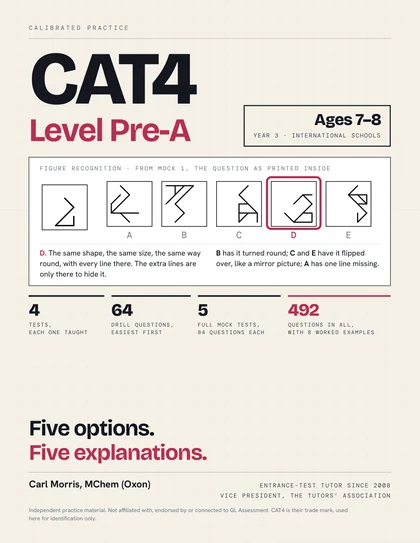
A small shape made of a few straight lines is shown on the left. On the right are five pictures, A to E, most with more lines in them. The small shape is hidden in exactly one of them, the same size and the same way round. Find it.

Traps the chapter names: mirrored · rotated · altered · stretched · absent

Figure Recognition · worked example

ABCDE
Show the answer, and why each of the other four is wrongHide the answer
Answer A
The shape is in A, the same size and the same way round.
B has the shape turned round: the same lines, but not the same way up.C has no copy of the shape at the same size, any way round.D has the shape turned round: the same lines, but not the same way up.E has the shape turned round: the same lines, but not the same way up.Traps: B rotated · C absent · D rotated · E rotated

No surprises on the day.

CAT4 Level Pre-A, for Year 3. 492 questions, every option explained.

Questions about Level Pre-A

Is Level Pre-A the right level for my child?

Level Pre-A is the version a school normally uses in Year 3, with children aged 7–8. The school chooses the level from the year group, not from ability. Level Pre-A is the other Year 3 level, used mainly by international schools in place of Level Y. If you are not sure, ask the school which level it uses before you buy.

How long is the CAT4 Level Pre-A test?

The timed tests add up to 37 minutes, in two parts: Figure Classification (10 minutes), Verbal Classification (10 minutes), Number Series (8 minutes), Figure Recognition (9 minutes). Instructions and practice items come on top of that.

What is in the book?

492 original questions: 8 worked examples, 64 practice questions ordered from easy to hard, and five full mock tests of 84 questions to the published time limits, each with an error grid. Every answer explains all five options. A final part for the adult covers the school's report, pacing, English as an additional language and access arrangements.

What changed in the November 2026 revised edition?

New kinds of figure question, recalibrated number and shape questions, and fuller answers: every wrong option in the word questions now has its own reason, and figure answers show a small picture of the right option.